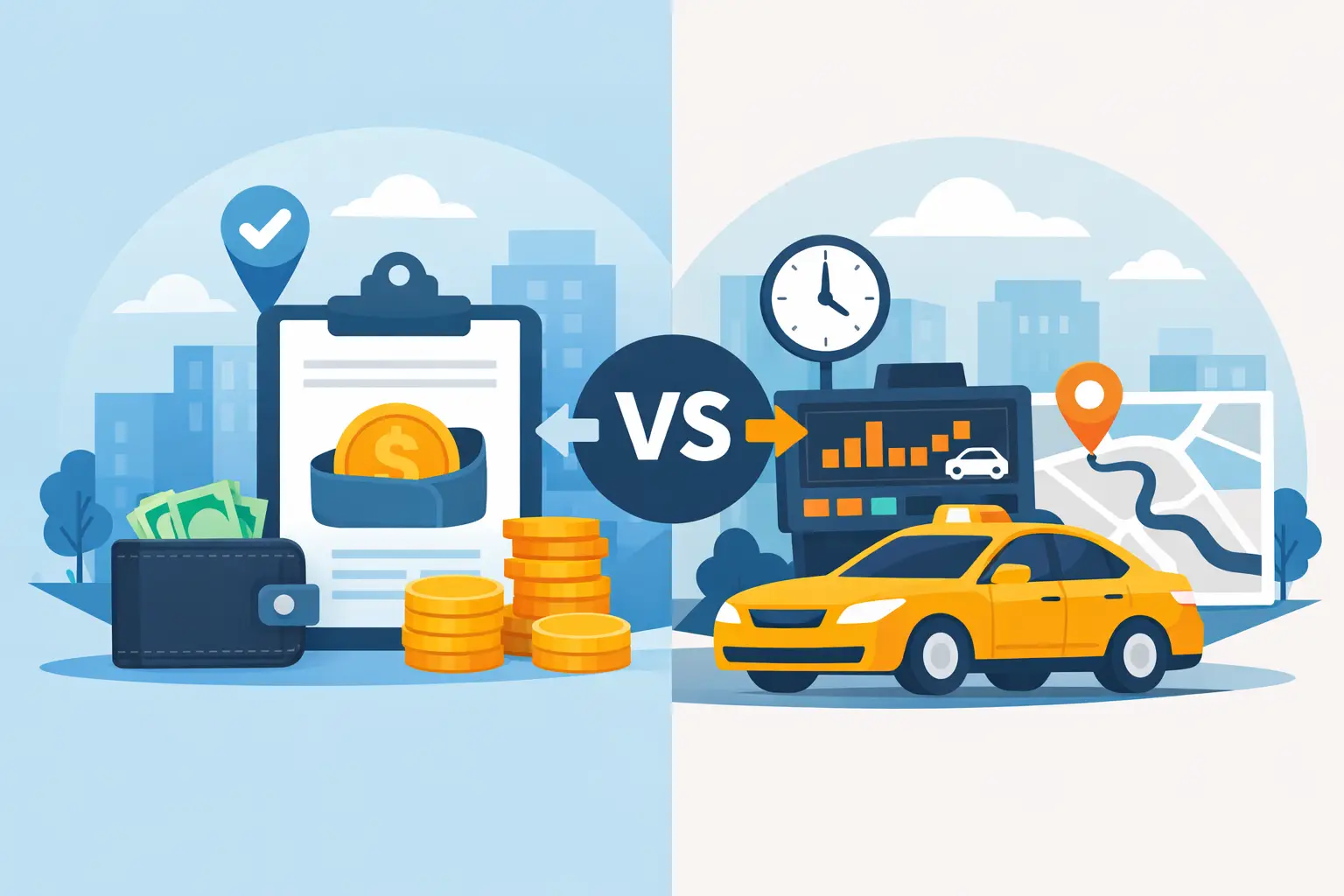
You land at Keflavík, it is late, the weather is rough, and the last thing you want is to guess what your taxi will cost. That is where the fixed fare vs meter question matters. The right choice depends on where you are going, how predictable the route is, and how much price certainty you want before the ride starts.
For most riders, this is not really a debate about taxi theory. It is about avoiding surprises. If you are heading between Reykjavík and Keflavík Airport, a fixed fare usually gives you clearer expectations. If you are taking a shorter ride around town with a straightforward route, a meter can be perfectly fair. The key is knowing when each pricing method works in your favor.
Fixed fare vs meter: the basic difference
A fixed fare means the price is agreed before the trip begins. You know what you will pay for that route, and the amount does not change because of traffic, red lights, or a slightly longer travel time. This model is especially useful for airport transfers and other common routes where travelers want a simple, predictable quote.
A metered fare is calculated during the ride. The taxi meter tracks distance and time, then applies the local rate. If the trip takes longer because of traffic or delays, the total can go up. If the roads are clear and the route is short, the final fare may be lower than a fixed price on some journeys.
Neither option is automatically better in every case. What matters is the route, the timing, and your tolerance for uncertainty.
When a fixed fare makes more sense
Fixed pricing is usually the safer choice when you are traveling to or from the airport, booking for a family, arriving at odd hours, or trying to stay on budget. Airport transfers are the clearest example. Most travelers want to know the cost before pickup, not after baggage claim and a 45-minute drive.
A fixed fare also helps when you are visiting Iceland for the first time. If you do not know local taxi rates, road conditions, or likely trip times, a pre-agreed price removes the guesswork. You can compare options, book quickly, and move on.
This is also the better setup for business travelers and anyone managing expenses. A set price makes receipts easier to reconcile and avoids awkward conversations about why the final amount was higher than expected. For groups, the benefit is even more obvious. If several people are sharing one airport transfer, it is easier to split a known total than estimate a metered ride that is still running.
There is also a trust factor. Transparent fixed pricing signals that the operator is comfortable showing the cost upfront. That matters in any market, but especially in a place where many riders are visitors and may not know what a normal fare should look like.
When a metered fare is the better option
Metered pricing works well for local city rides where the trip is short, direct, and not easy to pre-price in a useful way. If you need a ride across Reykjavík, the meter may be the most practical and fair approach. You pay for the actual ride rather than a broad estimate.
This can also work in your favor when roads are clear and demand is normal. A short metered trip may come in lower than a fixed quote designed to cover variability. If you are a local rider who already understands how taxi rates work, a meter often feels familiar and straightforward.
Metered rides are also useful when the destination may change, when you need a stop along the way, or when the trip is open-ended. In those cases, a fixed fare can be harder to apply fairly because the ride is not fully defined at the start.
That said, metered pricing asks you to accept some uncertainty. If traffic builds, if there is roadwork, or if pickup happens during a busier period, the final total can move upward. That does not mean the fare is unfair. It just means the price is reacting to real trip conditions instead of staying locked in.
Airport transfers are where fixed fares stand out
The Reykjavík-Keflavík Airport corridor is one of the easiest places to see the value of fixed pricing. The route is common, demand is consistent, and many riders care more about certainty than small fare variations. After a flight, most people are not trying to optimize for the lowest possible number by a narrow margin. They want a licensed driver, a verified vehicle, a safe pickup, and a clear fare.
That is why fixed airport pricing tends to be the stronger option. You know the cost before the car arrives. You are not watching the meter while traffic slows. You are not trying to estimate how much your bags, arrival time, or weather conditions might affect the total.
For early-morning departures, the same logic applies. A fixed fare lets you plan the ride as part of the trip, not as a variable expense that still needs to reveal itself.
The real trade-off is certainty vs flexibility
Most riders frame fixed fare vs meter as a question about cost alone, but the bigger issue is certainty. A fixed fare gives certainty and easier planning. A meter gives flexibility and charges based on actual time and distance.
If your route is standard and your priority is knowing the price in advance, fixed is usually the stronger choice. If your route is short, local, or likely to change, metered pricing may be more practical.
This is why good taxi operators often use both models. It is not inconsistent. It is operationally sensible. Airport routes benefit from transparent fixed pricing. City rides often fit a meter better. Longer out-of-town trips may go either way depending on whether the route is standard, whether waiting time is involved, and whether the customer wants a locked-in quote.
How to choose before you book
A simple way to decide is to ask what would bother you more: paying slightly more than the lowest possible fare, or not knowing the final total until the ride ends. For many visitors, uncertainty is the bigger problem. For experienced local riders, it may not be.
If your pickup is at the airport, if you are carrying luggage, if the trip is important, or if you are booking late at night, fixed pricing is usually worth it. The cost is clear, the process is easier, and there is less room for stress.
If you are taking a normal ride in town and the route is simple, the meter is often the right tool. It reflects the ride as it happens. That can be fair and efficient when the trip is short and conditions are stable.
You should also look at the service around the fare, not just the fare itself. A low price means less if the operator cannot confirm the booking, provide support, or show clear safety standards. Licensed drivers, verified vehicles, maintained cars, and 24/7 support matter just as much as the pricing model. In practice, the best booking experience combines transparent pricing with operational reliability.
What smart riders look for
Before confirming any taxi, check whether the fare method is clearly explained. If it is fixed, the amount should be stated plainly. If it is metered, the operator should make that clear before pickup. Hidden ambiguity is usually where frustration starts.
It also helps to choose a service that makes booking easy. Online reservations, app-based ordering, live tracking, and support through channels people already use can save time and reduce confusion. That matters even more when you are arriving in a new country, managing a family, or traveling on a schedule.
For riders in Iceland, the strongest setup is usually simple: fixed fares for airport transfers, metered fares for city trips, and clear communication for everything else. That is the model practical travelers tend to trust because it matches the trip instead of forcing one pricing method onto every situation.
Flott Taxi Iceland follows that logic because it is what most customers actually need - fixed and transparent pricing for airport routes, metered pricing for city rides, and clear booking support around the clock.
The best choice is usually the one that removes friction before the car even arrives. If a fixed fare gives you confidence, take it. If a meter fits the trip better, that is fine too. What matters most is that the pricing is honest, the driver is licensed, and you know what kind of ride you are booking before the door closes.